
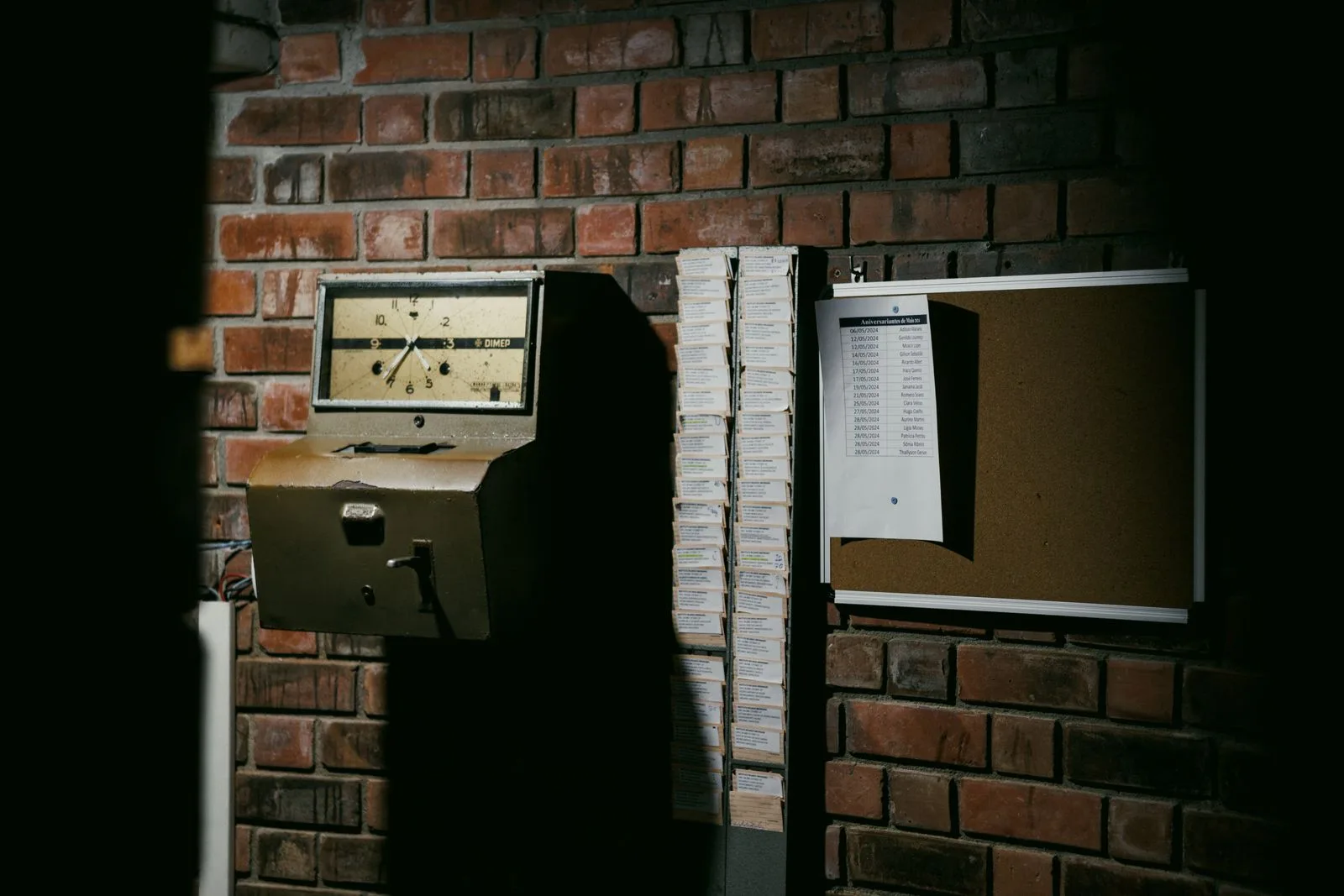
It's Sunday night. You're at the kitchen table with a stack of timesheets, a calculator, and a cup of coffee that's gone cold. One line just says "7-3ish." Another one is smudged. You're pretty sure that's a 9, but it could be a 7. Tomorrow morning, payroll is due, and you're trying to turn someone's handwriting into a paycheck.
If that sounds familiar, you're not alone, and you're not doing anything wrong. Paper timesheets and punch clocks have worked for decades. But "worked" and "free" are not the same thing. Paper doesn't send you a bill. It just quietly costs you in ways that never show up as a single line item, so most owners never add them up.
The Costs Hiding in the Handwriting
Here's the first one: buddy punching. That's when one employee clocks in or out for another who isn't there yet, or has already left. It's usually small and friendly, not malicious — a coworker covers for someone stuck in traffic. But it happens more than most owners realize. Estimates from payroll industry groups suggest time theft like this can cost a business a few percent of total payroll a year, which adds up to real money even on a modest payroll.
The second cost is quieter, and it's nobody's fault: rounding. When someone writes "8 to 4" instead of the actual 8:07 to 4:12, those extra minutes usually round in the employee's favor. Seven minutes here, five there, multiplied by every shift, every employee, every week. Nobody is stealing — it's just how handwriting and memory work. But it's still hours you're paying for that were never worked.
Then there's the Sunday-night problem itself: unreadable or unclear entries. A "7" that looks like a "9." A missing lunch break, reconstructed from memory a week later. Every one of these forces you to guess, and every guess either shortchanges an employee or overpays one.
The Hours You Lose Just Doing the Math
Even when the handwriting is clear, someone still has to turn it into a paycheck: adding up hours by hand, checking for overtime, fixing entries that don't add up, and typing it all into your payroll system. Industry estimates for manual payroll processing commonly land between two and ten hours per pay period, depending on how many employees you have. Run payroll every two weeks, and that's dozens of hours a year spent on arithmetic, not on your business.
That number doesn't even count the follow-up: the employee who says their check is short, the conversation about what happened that Tuesday, the correction that has to go through next cycle. Manual timesheets don't just cost you time once. They cost you time, and then a second, smaller round of time fixing the first mistake.
What Good Time-Tracking Software Should Actually Do
A lot of small business owners hear "time-tracking software" and picture something complicated, expensive, or built for a company ten times their size. It doesn't have to be any of that. Good time-tracking software does a small number of things, and does them well:
- Clock in and out with real accuracy. A timestamp, not a guess. No more deciphering handwriting.
- Flag anything unusual automatically. A shift that runs long, a missed clock-out, a break that never happened — the system catches it instead of you finding it three weeks later.
- Let managers approve hours in a few clicks. Not retype them. Not re-add them. Just review and approve.
- Export clean numbers straight into payroll. No transcribing. No typing the same number twice.
That's really the whole job. If a tool does those four things simply, it's doing what it's supposed to do. Everything beyond that — face scans, GPS tracking, elaborate dashboards — is optional, and for most small teams, unnecessary.
How It Makes Payroll Faster and More Accurate
This is the part that actually saves you money, not just time. Once hours are captured digitally and accurately, the tedious work disappears. No adding on a calculator. No guessing at handwriting. No rounding that quietly favors anyone. The numbers that go into payroll are the numbers that were actually worked.
That has a ripple effect: fewer disputes about paychecks, fewer corrections the following cycle, and the person who used to spend a chunk of payroll day on manual math gets that time back for customers, scheduling, or anything else that grows the business. This is the same principle behind going digital in other parts of your business: the win isn't a fancier system, it's the hours of your week that were quietly disappearing into paperwork.
Introducing It Without It Feeling Like Surveillance
Here's what stops most owners from making this change, even after they've decided it makes sense: they worry their team will see it as being watched. That worry is fair, and it's worth taking seriously.
The fix is mostly about how you introduce it. Explain the actual reason, in plain terms: "This isn't about checking up on anyone. It's so nobody has to guess at handwriting, and everybody gets paid for exactly what they worked, including the extra ten minutes that used to get rounded away." That last point tends to land well, because accurate tracking protects the business from errors, and protects employees from being shortchanged too.
Start with one team or one week as a trial, not a company-wide switch overnight. Let people ask questions. Expect a few clumsy days while everyone gets used to a new clock-in routine — that's normal, not a sign it's failing. If you've read what I've written about figuring out which tasks are actually worth fixing first, this is a textbook example: a task that happens every day, costs real hours, and carries real risk of errors.
You Don't Have to Guess at Handwriting Anymore
Paper timesheets aren't a mistake. For a long time, they were the only option, and they got the job done. But "good enough for a long time" isn't the same as "still the cheapest option today." Between rounded minutes, occasional buddy punching, and the hours spent doing payroll math by hand, paper is quietly costing you more than a simple system would.
If you're curious what this would actually look like for your team, I'm glad to walk through it with you.